


Artificial intelligence is changing how organizations operate, and that change is also raising an important question for education: how should schools and vocational institutions prepare students for a workforce where AI is becoming part of everyday work?
This was one of the key themes surrounding the Smart Vocational Education Seminar held by BBPPMPV Bidang Mesin dan Teknik Industri (BBPPMPV BMTI) as part of the inauguration of its vocational gallery building.

The event brought together stakeholders from government, education, and industry to discuss the growing role of technology in vocational education. ASIX participated in the event as an industry representative, with Vernando Meico serving as one of the speakers at the Smart Vocational Education seminar.
Bringing an Industry Perspective to AI in Education
As AI continues to become part of different industries, vocational education has an increasingly important role in preparing students for the realities of the workplace.
The discussion around AI in education therefore goes beyond introducing new digital tools in classrooms. It also involves understanding what skills students will need, how educators can adapt their teaching approaches, and how educational institutions can stay connected to changes taking place in industry.
Through Vernando's contribution as a speaker, ASIX brought an industry perspective to this conversation, sharing insights on the development and application of AI in real-world environments.
For ASIX, the connection between technology and education is particularly relevant as the company continues to develop AI solutions across different sectors, including education.
Preparing Students for an AI-Enabled Workplace
AI is already being applied across a wide range of workplace activities, from information processing and content generation to data analysis, automation, and decision support.
This means that preparing students for the future of work requires more than teaching them how to use individual AI tools.
Students also need to understand how AI fits into their respective fields, how to work alongside AI-enabled systems, and how to evaluate and apply AI outputs appropriately.
For vocational education, this connection between learning and industry is especially important. The skills taught today need to remain relevant as technologies and workplace practices continue to evolve.
Strengthening Industry-Education Collaboration
Beyond the seminar discussion, the event also marked a concrete step in strengthening collaboration between industry and vocational education.
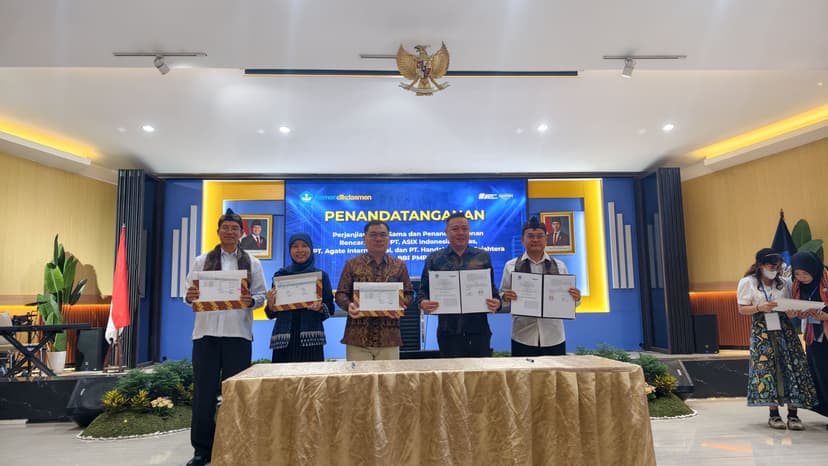
As part of the program, ASIX participated in the signing of a PKS with BBPPMPV BMTI. The event program also recorded the signing of a related RK involving PT ASIX Indonesia Cerdas, PT Agate International, and PT Handal Yesindo Sejahtera, with the agreements witnessed by representatives from government and education stakeholders.
The collaboration reflects the importance of connecting educational institutions with industry partners as technology continues to reshape the skills and capabilities required in the workplace.
For ASIX, partnerships with educational institutions provide an opportunity to contribute industry knowledge while supporting efforts to introduce relevant technology and perspectives into vocational education.
From Learning AI to Learning With AI
The role of AI in education is not simply about adding another technology to the curriculum.
It is about helping students understand how technology is changing the way work is performed and giving them the knowledge and skills to participate in that changing environment.
This also means creating stronger connections between what students learn in educational institutions and what organizations need in practice.
Through its participation in the Smart Vocational Education Seminar and its collaboration with BBPPMPV BMTI, ASIX continues to contribute to this conversation from an industry perspective.
As AI continues to reshape different sectors, collaboration between education and industry will be increasingly important in ensuring that the workforce is prepared not only to use AI, but to work effectively alongside it.